
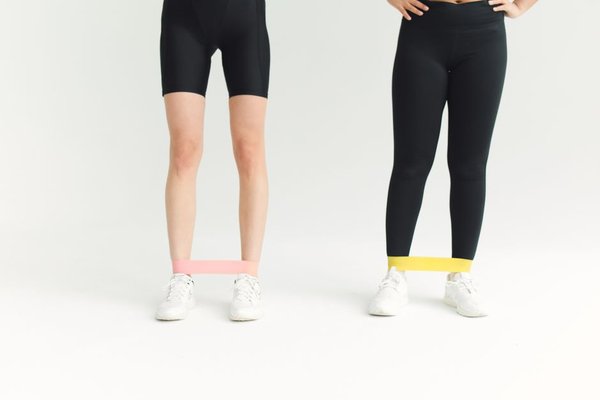
You do not need a rack of weights to train your whole body. A resistance band workout can challenge your legs, back, chest, shoulders and core in a small space, with equipment that fits in a drawer. The real advantage is adjustability: you can make a movement easier while learning it, then gradually increase the challenge without replacing your entire setup.
This band workout at home is built around straightforward movements rather than clever tricks. Allow about 25–35 minutes, including a warm-up. You can start with one set of each exercise, then add volume as your strength and confidence improve.
Choose a Band That Lets You Move Well
A long, flat loop band or a tube band with handles works for most of the routine. A small loop band is useful for the optional core exercise, but it is not essential. Resistance levels and colour codes vary between manufacturers, so judge tension by how the exercise feels rather than by the band’s colour.
For most sets, choose resistance that makes the final two repetitions challenging while still allowing smooth, controlled movement. If you have to jerk the band or shorten your range dramatically, use less tension. Check for tears, thin spots and damaged handles before every session. Wear secure shoes, keep the band away from your face, and avoid stretching it beyond the manufacturer’s instructions.
Your Full-Body Band Routine
Warm up for three to five minutes with marching, gentle squats, arm circles and easy hip hinges. Then perform the resistance band exercises below in order. Begin with one or two sets of 8–12 repetitions per movement, resting about 45–90 seconds between sets. For single-side exercises, complete both sides. Move slowly enough that the band never snaps back.
Band Squat: Legs and Glutes
Stand on the centre of a long band with feet approximately shoulder-width apart. Hold the ends at shoulder height, keeping enough slack to stand comfortably. Bend your knees and hips together to sit down between your legs, then drive through your feet to stand. Keep your knees tracking in the direction of your toes. For an easier version, squat to a sturdy chair; for more challenge, increase the band tension only after you can control every repetition.
Band Romanian Deadlift: Hips and Hamstrings
Stand on the band with feet hip-width apart and hold an end in each hand. Keep a slight bend in your knees, push your hips backwards and lower your hands along your legs. Stop when you feel your hamstrings working and can still keep your back comfortably neutral. Press through your feet and bring your hips forward to stand tall. Think of closing a car door with your hips rather than bending down to touch your toes.
Seated Band Row: Upper Back and Arms
Sit on the floor with knees slightly bent and loop the middle of the band securely around the soles of both feet. Hold the ends and sit tall. Draw your elbows back beside your ribs, gently bringing your shoulder blades together; then extend your arms under control. Keep the band positioned away from your face, and stop if it begins to slide off your shoes. A row balances the pressing movements that follow and makes your full body band routine more complete.
Standing Chest Press: Chest and Triceps
Place the band across your upper back, below the shoulder blades rather than around your neck, and hold an end in each hand. With elbows comfortably below shoulder height, press your hands forwards until your arms are nearly straight. Return slowly. Keep your ribs stacked over your hips instead of leaning backwards. If the band rubs painfully or the setup feels unstable, skip this version and use wall push-ups until you can find a comfortable band position.
Standing Shoulder Press: Shoulders and Triceps
Stand on the band, hold the ends at shoulder level and press upwards through a comfortable range. Avoid shrugging or arching your lower back to finish the lift. A lighter band often works better here than it does for squats. If overhead movement is uncomfortable, replace this exercise with a light front raise or another pain-free shoulder movement. Resistance training should feel demanding in the muscles, not sharp in the joints.
Core Finisher: Controlled Dead Bug
Lie on your back with arms pointed toward the ceiling and knees above your hips. Brace gently, then lower one heel toward the floor and return it before changing legs. Keep your lower back from arching. If you own a light mini loop, place it just above your knees and maintain slight outward pressure throughout. Perform six to ten slow repetitions per side. This core-focused finish needs almost no space and does not require an improvised door anchor.
Make the Resistance Challenging, Not Chaotic
For example, suppose you can complete two sets of 12 band rows comfortably for two workouts in a row. Next session, shorten your grip slightly or move to a stronger band and return to eight controlled repetitions. Alternatively, add a third set. Change one variable at a time and record the band and repetitions you used. A simple beginner strength training guide can help you understand how this gradual progression fits into a wider plan.
How Often Should You Train?
Try the routine twice weekly on nonconsecutive days, such as Monday and Thursday. Current U.S. physical activity guidance recommends muscle-strengthening activity for all major muscle groups on at least two days each week. You can add a third session when you recover comfortably and your schedule allows. On other days, walking and easy mobility exercises provide variety without turning every day into another hard workout.
Use a chair for balance if needed, reduce your sets when returning after a break, and allow time for soreness to settle. If you have an injury or medical condition that affects exercise, ask a qualified healthcare professional about appropriate modifications.
Frequently Asked Questions
Can resistance bands build strength?
Yes. Bands provide resistance that muscles work against, and strength can improve when exercises become progressively more challenging. The key is choosing enough tension, using good technique and training consistently.
Is a resistance band workout good for beginners?
Yes, because the movements can be scaled. Start with a lighter band, one set per exercise and a comfortable range of motion. Build control before adding repetitions or resistance.
How long should a full-body band workout take?
This routine typically takes about 25–35 minutes with a warm-up and short rests. A single-set version may be quicker; more sets and longer rests increase the duration.
Keep the Routine Simple Enough to Repeat
The best home strength routine is one you can perform safely and improve over time. Start with the main movement patterns, track a few basic numbers and resist the urge to rush into a stronger band. When your form stays steady and your sets become easier, you have a clear next step. For days without equipment, bodyweight home workouts can provide a useful alternative while keeping your training habit going.